
Strategic Planning and Scenario-Based Forescasting
Strategic foresight is not about predicting the future, it's about resilience in the face of major surprises
A 1997 study by Royal Dutch Shell found that the average lifespan of a large company is about 50 years. Companies often fail at the height of their success because of a failure to anticipate or adapt to change. (How big was Kodak just 15 years ago?)
What is Foresight?
If you want to develop better strategic policies--ones that are more resilient in the face of unpredictable market or social changes--then I can help. The strategic planning methods I use can assist companies, governments and other organizations in building the kind of resilience that will allow them to weather unexpected shocks. This kind of foresight should be a component of all long-term corporate and governmental planning.
My Role
For ten years now I've been periodically engaged in doing foresight consulting, with clients such as the Canadian government and army; in Canada, some of our conference findings went straight to the Prime Minister's office, and in October 2014 I was invited to the White House Office of Science and Technology Policy to discuss future possibilities. I can bring extensive experience in the following to your projects:
- Scenario-based forecasting I have extensive experience with scenario-based strategic planning, going back ten years in my own private practice. This includes:
- Horizon scanning
- Drivers analysis
- Scenario development and writing
- Back-casting
- Wind-tunneling
- Follow-through
- Session facilitation, results capture and public presentation I'm a good facilitator and speaker and have worked with diverse teams from government, industry and the military. As part of this activity, I've become experienced with many aspects of scenario-based foresight, including:
- Conference planning
- Break-out session lead, results capture and summary
- Public speaking, including giving keynote addresses
- Writing, including preliminary scenarios and summary reports My unique contribution is the ability to craft fictionalized dramatizations of foresight findings. Examples of this include the 27,000 word Crisis in Zefra, as well as shorter pieces such as the story "Community".
- Design of "serious games" I've designed and overseen "red versus blue" scenarios involving future conflicts and future technologies, for instance wargaming potential threats for the Vancouver Olympics. In 2014 I contributed to the latest World Bank Evoke online game design.
Master's Degree in Strategic Foresight
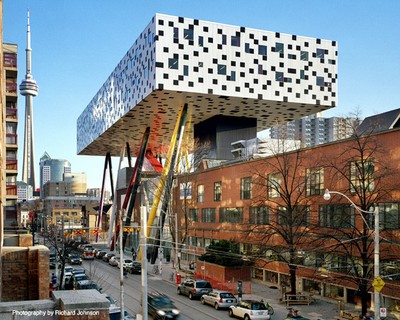
In October 2011 I was awarded the degree of Master of Design in Strategic Foresight and Innovation from OCAD University (our building was recently hailed as one of the 13 "strangest buildings in the world" by TravelandLeisure.com). This formalized my skills and experience in an area where I already did a good deal of work. My Major Project was the design of a technique within the general methodology of scenario development. The project is entitled Fiction as Foresight: Presenting Foresight Findings as Fiction, and is about the use of storytelling to highlight, synthesize or present the findings of some given foresight activity. (This makes it an activity distinct, for instance, from Brian David Johnson's notion of science fiction prototyping.) Copies of my formal report are available upon request.
Seminars, Colloquia and Consulting
- Participant and facilitator for the 2020 Media Futures foresight project (2010-11). Tasks include trends analysis and scenario design.
- Board members and attendee at SciBarCamp 2009, held May 8-9th at Hart House in Toronto.
- Organizer and board member for SciBarCamp,
the first of a series of self-organizing colloquia bringing together
scientists, technologists, artists and activists in Toronto. The first
event occurred March 14-16, 2008.
- Scenario designer, facilitator, presenter and writer for Prospective Protective Futures workshop at DRDC, Shirley's Bay, Ottawa, March 27-29th 2006, as well as its follow-up held March 21-22, 2007. These were foresight exercises for security experts, attended by about 60 people. Both were highly successful, and I managed to have a hand in all the critical exercises and activities.
- Contracted to write a dramatization, “Crisis in Zefra”, for the Defence R&D Canada (May-June 2004). This dramatization is a novella-length scenario detailing what military operations might be like in thirty years.
- Facilitator and scenario author for the 2004 NRC Foresight symposium, March 21-22nd 2004, held at NRC headquarters in Ottawa. This year's topic was the future of biotech and health care in Canada.
- Canada 2025, a two-day workshop held by the "Science and Technology Foresight Pilot Project" of the National Research Council, March 19 and 20, 2003, NRC headquarters, Ottawa. I was one of 80 specialists from all numerous professions called upon to make predictions about where Canada will be in 2025. Our predictions were presented as a policy paper to Cabinet.
- One of four panelists in a two-day colloquium with some of 2002's Canadian Millennium Scholarship laureates. The Millennium Excellence Awards National Conference, which has the title Think Again 2002 -- Exploring New Paths, took place in Ottawa, Ontario on September 27-28th, 2002.
Invited Talks and Readings
- Speaker and panelist at the 2011 Applied Brilliance conference and workshop, held Jackson Hole, Wyoming, October 11-14, 2011.
- Keynote speaker at Bringing Together Communities, an interdisciplinary studies conference at the University of Windsor, February 4, 2011.
- Keynote speaker at DRDC Managers' workshop, April 6-7, 2010.
- Keynote speaker at O'Reilly Publishing's Open Source Conference 2009, held in San Jose, California, July 24, 2009. The subject: "rewilding" the human species.
Keynote speaker at Toronto Public Library's Reader's Services Committee annual meeting, June 18, 2009. Subject: the future of publishing and writing. - Moderator, Green Careers panel, University of Toronto Careers Centre, January 24, 2007.
- Keynote speaker at 2004 Defense R&D Canada Science and Technology symposium, April 21-22, 2004. The theme of the symposium was "Computers Everywhere and in Everything". My keynote speech was on Imagined Worlds.
- Keynote speaker at the 2004 NRC Foresight Symposium, March 21-22nd 2004, held at NRC headquarters in Ottawa. This year's topic was the future of biotech and health care in Canada.
- I was invited to address members of the American Library Association at their annual convention. The seminar, held on June 21, 2003 was very well attended (over a hundred in the audience). A written version of my talk subsequently appeared in The New York Review of Science Fiction under the title "Traitor to Both Sides".
- Invited participant at the 2003 Science Fiction Research Association annual meeting, held in Guelph, Ontario, June 22, 2003.
- I am regularly invited to give readings and sit on panels at science fiction conventions across the continent and internationally. Since 2000, I've attended the annual World Science Fiction convention (held in places as diverse as Glasgow, San Jose and Toronto). I have also been a regular guest at Toronto's Ad Astra convention for many years.
 Home
Home


 Forgot your password?
 New user?
