Skip to content. | Skip to navigation
- Downloads
-
I've made my first novel, Ventus, available as a free download, as well as excerpts from two of the Virga books. I am looking forward to putting up a number of short stories in the near future.
Complete novel: Ventus
To celebrate the August, 2007 publication of Queen of Candesce, I decided to re-release my first novel as an eBook. You can download it from this page. Ventus was first published by Tor Books in 2000, and and you can still buy it; to everyone who would just like to sample my work, I hope you enjoy this version.
I've released this book under a Creative Commons license, which means you can read it and distribute it freely, but not make derivative works or sell it.
Book Excerpts: Sun of Suns and Pirate Sun
I've made large tracts of these two Virga books available. If you want to find out what the Virga universe is all about, you can check it out here:
Major Foresight Project: Crisis in Zefra
In spring 2005, the Directorate of Land Strategic Concepts of National Defense Canada (that is to say, the army) hired me to write a dramatized future military scenario. The book-length work, Crisis in Zefra, was set in a mythical African city-state, about 20 years in the future, and concerned a group of Canadian peacekeepers who are trying to ready the city for its first democratic vote while fighting an insurgency. The project ran to 27,000 words and was published by the army as a bound paperback book.
If you'd like to read Crisis in Zefra, you can download it in PDF form.

green tech
Jan 11, 2012
Polyethylenimine
Possibly the most important word in the world right now
Slashdot. Ah, Slashdot! So much gets reported there, and so often is it mauled in the comment threads. Take this recent thread on the discovery of a way to increase the CO2 absorbent qualities of a particular plastic. I actually made this subject one of my projects at school, and have posted a tiny summary of our findings elsewhere on this site.
Slashdot's usual pundits reacted to this little news item with derision and bewilderment. However, if this simple plastic both absorbs and releases its CO2 rapidly, and if it can withstand more than a few hundred cycles of doing it before deteriorating, it could literally save the planet. There's really nothing else out there you could say the same about.
It's like this: if you chase the references at the bottom of my page on carbon air capture, you'll discover that no amount of emissions reductions nor geoengineering of global temperature will prevent climate disaster at this stage. Even if we stopped putting new carbon dioxide into the atmosphere overnight, what's already there will continue to acidify the oceans and alter the climate for centuries. We are already on an irreversible course to mass extinction.
...Unless it somehow became feasible to remove the CO2 that's already in the air. Some of the Slashdot commentators naively suggested planting trees, but that's not actually a viable solution (especially as we are cutting trees down far faster than we can reforest, and the climate will kill forests faster than we can replant them anyway). What's needed is an industrial-scale solution. People like David Keith and Klaus Lackner have experimentally proven that it can be done, and even Keith's system, which uses off-the-shelf chemicals and processes, is economically viable provided there's a high price on carbon. However, if the polyethylenimine results hold up, they'll represent an orders-of-magnitude reduction in the difficulty of capturing atmospheric carbon. This translates to commercial viability at a credible carbon price.
In other words, we don't have to either bury our heads in the sand or accept the inevitability of mass desertification, mass extinction, ocean anoxia and economic catastrophe. When combined with actual emissions reductions, carbon air capture technology has the potential of returning the atmosphere to pre-industrial levels of CO2 within our lifetimes. It is the only measure that can actually reverse climate change.
So remember the word polyethylenimine. This unassuming plastic might just save the world.
Dec 28, 2011
If I had a Billion Dollars: Holiday Edition
My occasional game of speculation about how best to fund the future
I've played this game before--and I will again. I find it clears the mind wonderfully to wonder what you'd do for the world if you had a billion dollars to spend. Build a secret volcanic island lair? Check. Cure necrotizing phlombosis? Check. Oh, there's all kinds of stuff you could do.
--There's one rule, though: whatever you spend your billion on, it has to be something nobody else is doing--and something that's worthwhile in a completely game-changing way.
After all, in today's market a billion dollars will get you a few miles of subway, or a new sports stadium. Yay. But it can get you so much more, as Elon Musk has demonstrated with his reinvention of the space launch business (and he hasn't spent more than a fifth of a billion on that). In fact, a billion is enough to solve more than one problem, if it's properly distributed.
I play this game regularly because the world keeps changing, and what's important keeps changing. Some items remain from previous lists; some are new. Here's today's list:
- $200 million to studying and developing new systems of governance. --No, I don't mean e-voting, or even e-democracy. I'm talking about a systematic study of how humans govern themselves, and how our cognitive biases and interactions at different scales scuttle effective problem-solving among groups. Think this is fringe science? I happen to think it's the most important problem in the world, the only one that counts. Because if we reinvented governance (on the level of individual self-control and choice, on the level of small-group interactions, and all the way up to how millions of people make collective decisions) then every other problem facing us now would become tractable. So I'd be exploring cognitive science, promise theory, structured dialogic design and a lot else besides. $200 is really far too little to spend on this, but it's a start.
- $200 million to develop efficient and economical carbon air capture and sequestration. Carbon air capture is the only potentially feasible method of returning Earth's atmospheric CO2 balance to pre-industrial levels in less than a hundred years. Emissions controls won't do it, neither will renewable energy, or even the complete disappearance of human civilization. The CO2's there. It has to actually be removed from the atmosphere. Currently, far less than $1 million is spent per year on how to do this. And that's just crazy.
- $200 million to develop a microwave space launch system. --Again, this sounds wacky. But the physical resources of the solar system are effectively infinite; and the world looks like a very different place if you play the game of imagining that access to space was really cheap. All sorts of currently impossible problems fall like dominoes if it costs as little to get to space as it does to fly across the Atlantic. And, in space development, there is only one problem, and that's the cost of going the first 100 miles. Literally every other issue becomes tractable if you solve that one. So let's stop dicking around with incredibly expensive launch systems and solve it. (Why microwave launch and not laser launch? Because microwaves are more energy efficient, and can be done now; and because I think laser launch is a political non-starter, because accidental or deliberate straying of a laser launch beam could blind or fry anything in the sky, including airliners or other nations' satellites.)
- $200 million to finally realize the dream of nuclear fusion energy. We are that close. Most of the money would be divided up between the chronically-underfunded research projects that are getting close: IEC fusion, magnetized-target fusion, and several others. I'd fund General Fusion's steampunk pneumatic-fusion system, for instance. But I'd also fund one method that nobody's trying right now, but may be the best of all: levitating dipole fusion.
- $200 million to prototype the business models, supply chains and build a first-generation Vertical Farm. Because sane governance, free energy, a solution to global warming and unlimited material resources aren't enough if half the planet's starving, which will be the case in forty years if we don't act now. This one seems like a no-brainer, if it can be properly optimized.
An odd set of priorities? But, what if they all worked? Simultaneous breakthroughs in energy, resource access including food, removal of the threat of global warming, remediation of the natural environment destroyed by intensive agrivulture and, most importantly, a Renaissance in collective problem-solving would literally mean the world to us.
The point of all this should be clear. Even in a global recession, money's not the scarce commodity. Audacity is.
What can you do with a billion dollars?
You can build a new sports stadium.
Or, maybe, you can save the world.
Oct 17, 2011
Some numbers to argue about
Which is more efficient, electricity or gasoline? A complicated and surprising answer...?
I've been waxing nostalgic lately over the placidity of my blog in comparison to the knock-down, drag-out free-for-all that is Charlie Stross's (where I guest-blogged for a couple of weeks this summer). So I thought I'd share an interesting bit of data that came across the twitterverse yesterday and (while it may not be news to you, is news to me) bears some contemplation. It is simply this:
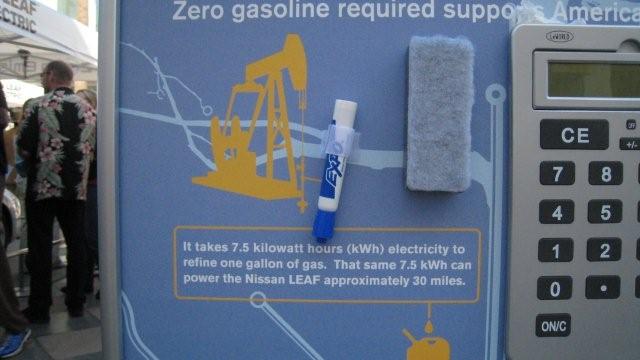
According to various sources, including apparently the United States Department of Energy, it takes between 4 and 7.5 kWh of energy to refine one gallon of gasoline. To drill and transport that gas takes another 1.5-3 kWh. So, the average energy cost of one gallon of gas is roughly 8 kWh, or even more.
A lot of that energy is provided by fossil fuels, chiefly natural gas; but a big proportion of it is provided in the form of electricity. Those who have totaled it up find that a gasoline-powered automobile uses more electricity to run per mile than a comparable electric vehicle. The total energy cost of the gasoline economy is therefore at least double that of an electric economy.
A corollary to this is that a complete conversion to electric vehicles would not place any more strain on the grid than there is now; it would simply distribute it (because right now much of that energy is going to fixed installations, and with an EV economy it would be going, at least potentially, to millions of individual houses). So a 100% EV economy would not require any increase in electricity production, only an upgrade to the grid (and lots of companies, such as GM, are designing that grid). In fact, all things being equal, in a 100% EV world, electricity demand should go down somewhat.
The remaining issue for electric vehicles, then, would be battery disposal, because their toxicity is high when they contain lead, but with Li batteries is becoming lower and lower.
Except that...
This isn't quite the whole story. What remains to be factored in here is the electricity cost of manufacturing the EV's batteries. I haven't yet found numbers for this cost; if anybody can supply it, that would be helpful.
And while we're at it, we should do a complete parts count for the additional complexity and wear-out rate of internal combustion engines, and factor in the electricity cost of those components...
...And round and round we go.
May 31, 2010
Rewilding Humanity
I'm giving a speech this friday, June 4, 2010 at Innis Town Hall
As part of the 13th annual Subtle Technologies Festival here in Toronto, I will be giving a talk on Friday, June 4 on the subject of Rewilding Humanity. Those of you who followed my old blog, "Age of Embodiment," will have some inkling of what this stuff is about; as will those who may have caught my OsCon speech last summer (which you can catch on YouTube here).
Here's the precis of the talk from the Subtle Technologies website:
Economic sustainability is not enough if human civilization is going to have a long presence on Earth. We need to not only reform our institutions but redefine what they are and how they operate; and we need a new vision of what it means to be human in a world where neither transcendence or apocalypse are viable options. One possibility is “rewilding”–bringing our constructed environments in line with our instinctive and cognitive needs.
This is a good description; but there's a lot more to it than that. If you can make it to the festival, come to the event and we can discuss these and, hopefully, many related ideas.
Oct 08, 2009
Another nail in the coffin for the "tragedy of the commons"
Local communities manage forests better than governments, reports New Scientist
Few ideas have been so thoroughly misused as Garrett Hardin's notion of the tragedy of the commons. Hardin's idea was that "multiple individuals acting independently and solely and rationally consulting their own self-interest will ultimately destroy a shared limited resource even when it is clear that it is not in anyone's long term interest for this to happen" (to quote Wikipedia). There are some historical cases of this happening (i.e. the Boston commons). There are, however, many more cases where it did not; and the idea is often used to try to justify the privatization of public goods.
I've found when I travel to the United States that the tragedy of the commons is a popular idea there, despite the fact that the historical evidence for it is equivocal, at best. Commons were a widespread feature of European life for centuries, and mismanagement of them was extremely rare. Now, New Scientist reports on a new study that shows that forests that are managed locally (i.e. as a commons) sequester more carbon than institutionally, governmentally or privately managed forests.
One significant comment in the article was the following:
They argue that their findings contradict a long-standing environmental idea, called the "tragedy of the commons", which says that natural resources left to communal control get trashed. In fact, says Agrawal, "communities are perfectly capable of managing their resources sustainably".
This really comes as no surprise. But it needs to be reinforced, particularly for people who've drunk the koolaid of the notion that public goods either can't exist or can't be managed efficiently.
Sep 20, 2009
Things may be about to change
...In a big way
While our attention was elsewhere, a truly earth-shattering change has been in the wind--a development most experts have dismissed as impossible, but which now increasingly looks like it is going to happen.
According to Lyle Dennis over at the AllCarsElectric blog, EEStor has applied for certification from the Underwriter's Laboratories for its ultracapacitor technology. If this is true, then the secretive company may really have succeeded in creating the ultimate in electricity-storage technology: a device capable of running your car for hundreds of miles on one charge, and of recharging in under five minutes. A device that is not a battery, and hence never wears out. A technology that would make intermittent power generation sources such as windmills directly competitive with baseload generation sources such as coal.
Canadian electric car company Zenn Motors has licensed EEStor's technology for a soon-to-be-built fully electric sedan. Zenn is betting the farm on EEStor, and they seem remarkably confident. Naturally, we hear outrageous claims about new technologies nearly every day; and many industry watchers have been skeptically tracking EEStor for years. The expectation has been that any day now, the company would disappear, and its executives would later be found living high off the land in Ecuador or somewhere. That hasn't happened, and now the company appears poised to release an actual product--according to Zenn, by the end of the year.
If it happens, this will be a truly disruptive change. It would be nothing less than the first nail in the coffin of the fossil fuel age.
And here's more on the developing story, from Zenn's point of view.
 Home
Home


 Forgot your password?
 New user?
- About Me

-
I'm a member of the Association of Professional Futurists with my own consultancy, and am also currently Chair of the Canadian node of the Millennium Project, a private/public foresight consultancy active in 50 nations. As well, I am an award-winning author with ten published novels translated into as many languages. I write, give talks, and conduct workshops on numerous topics related to the future, including:
- Future of government
- Bitcoin and digital currencies
- The workplace in 2030
- The Internet of Things
- Augmented cognition
For a complete bio, go here. To contact me, email karl at kschroeder dot com
- Example: The Future of Governance
I use Science Fiction to communicate the results of actual futures studies. Some of my recent research relates to how we'll govern ourselves in the future. I've worked with a few clients on this and published some results.
Here are two examples--and you can read the first for free:
The Canadian army commissioned me to write Crisis in Urlia, a fictionalized study of the future of military command-and-control. You can download a PDF of the book here:

Crisis in Urlia-
For the "optimistic Science Fiction" anthology Hieroglyph, I wrote "Degrees of Freedom," set in Haida Gwaii. "Degrees of Freedom" is about an attempt to develop new governing systems by Canadian First Nations people.
I'm continuing to research this exciting area and would be happy to share my findings.
- Tag Cloud
- Ashes of Candesce Audiobooks Aurora Awards, conventions Australia Crisis in Urlia Crisis in Zefra Firefly Foresight, Scenario Fictions Gennady Malianov Graphic Novels Graphic novels Guest blogging Hieroglyph Keynote addresses Lady of Mazes Lockstep METAtropolis Mars Masters degree, blogging Millennium Project Permanence Pirate Sun Queen of Candesce Scalzi Sci foo SciBarCamp Stealing Worlds Sun of Suns Sunburst award The Claus Effect The Engine of Recall The Million The Rewilding The Sunless Countries Ventus Virga Virga 1.2 Virga: Cities of the Air astronomy award ceremonies award nominations awards book launches book sales book signings coming soon congrats contests conventions cool ideas cover art drudgework ebooks excerpts exoplanets, astronomy foreign sales foresight free stuff future projects green tech guest of honour humour interviews madness news online chats ordinary bragging philosophy podcasts polemics politics public panels public speaking purses readings retro replays reviews sales shameless bragging shameless cadging short stories software symposia talks teaching technology translations travel video website additions workshops writer in residence
- Weblog Archive
-
-
Year 02
-
Year 02
-
Year 02
-
Year 02
-
Year 02
-
Year 02
-
Year 02
-
Year 02
-
Year 02
-
Year 02
-
Year 02
-
- Quills
-

-

-

-

- Mailing List
-
- Coming on June 18, 2019
"Science fiction at its best."
--Kim Stanley Robinson
- A Young Adult Scifi Saga
"Lean and hugely engaging ... and highly recommended."
--Open Letters Monthly, an Arts and Literature Review
- Sheer Fun: The Virga Series
(Sun of Suns and Queen of Candesce are combined in Cities of the Air)
“An adventure-filled tale of sword fights and naval battles... the real fun of this coming-of-age tale includes a pirate treasure hunt and grand scale naval invasions set in the cold, far reaches of space. ”
—Kirkus Reviews (listed in top 10 SF novels for 2006)
"With Queen of Candesce, [Schroeder] has achieved a clockwork balance of deftly paced adventure and humour, set against an intriguing and unique vision of humanity's far future.
--The Globe and Mail"[Pirate Sun] is fun in the same league as the best SF ever has had to offer, fully as exciting and full of cool science as work from the golden age of SF, but with characterization and plot layering equal to the scrutiny of critical appraisers."
--SFRevu.com
"...A rollicking good read... fun, bookish, and full of insane air battles"
--io9.com
"A grand flying-pirate-ship-chases-and-escapes-and-meetings-with-monsters adventure, and it ends not with a debate or a seminar but with a gigantic zero-gee battle around Candesce, a climactic unmasking and showdown, just desserts, and other satisfying stuff."
--Locus
- Recent Comments
- Coloinizatio (Anonymous User)
- Halogen Creative - Why Company logos and Business Brands Is so important? (insitglobl33)
- Automotive Appearance Pros. Inc. - Levelling Up Car Outlining (insitglobl33)
- Halogen Creative - Why Company logos and Business Brands Is so important? (insitglobl33)
- Rotogrinders - Fantasy Sports info (insitglobl33)
- Weblog Authors
-
Karl Schroeder
Location: Canada