green tech
Jan 11, 2012
Polyethylenimine
Possibly the most important word in the world right now
Slashdot. Ah, Slashdot! So much gets reported there, and so often is it mauled in the comment threads. Take this recent thread on the discovery of a way to increase the CO2 absorbent qualities of a particular plastic. I actually made this subject one of my projects at school, and have posted a tiny summary of our findings elsewhere on this site.
Slashdot's usual pundits reacted to this little news item with derision and bewilderment. However, if this simple plastic both absorbs and releases its CO2 rapidly, and if it can withstand more than a few hundred cycles of doing it before deteriorating, it could literally save the planet. There's really nothing else out there you could say the same about.
It's like this: if you chase the references at the bottom of my page on carbon air capture, you'll discover that no amount of emissions reductions nor geoengineering of global temperature will prevent climate disaster at this stage. Even if we stopped putting new carbon dioxide into the atmosphere overnight, what's already there will continue to acidify the oceans and alter the climate for centuries. We are already on an irreversible course to mass extinction.
...Unless it somehow became feasible to remove the CO2 that's already in the air. Some of the Slashdot commentators naively suggested planting trees, but that's not actually a viable solution (especially as we are cutting trees down far faster than we can reforest, and the climate will kill forests faster than we can replant them anyway). What's needed is an industrial-scale solution. People like David Keith and Klaus Lackner have experimentally proven that it can be done, and even Keith's system, which uses off-the-shelf chemicals and processes, is economically viable provided there's a high price on carbon. However, if the polyethylenimine results hold up, they'll represent an orders-of-magnitude reduction in the difficulty of capturing atmospheric carbon. This translates to commercial viability at a credible carbon price.
In other words, we don't have to either bury our heads in the sand or accept the inevitability of mass desertification, mass extinction, ocean anoxia and economic catastrophe. When combined with actual emissions reductions, carbon air capture technology has the potential of returning the atmosphere to pre-industrial levels of CO2 within our lifetimes. It is the only measure that can actually reverse climate change.
So remember the word polyethylenimine. This unassuming plastic might just save the world.
Dec 28, 2011
If I had a Billion Dollars: Holiday Edition
My occasional game of speculation about how best to fund the future
I've played this game before--and I will again. I find it clears the mind wonderfully to wonder what you'd do for the world if you had a billion dollars to spend. Build a secret volcanic island lair? Check. Cure necrotizing phlombosis? Check. Oh, there's all kinds of stuff you could do.
--There's one rule, though: whatever you spend your billion on, it has to be something nobody else is doing--and something that's worthwhile in a completely game-changing way.
After all, in today's market a billion dollars will get you a few miles of subway, or a new sports stadium. Yay. But it can get you so much more, as Elon Musk has demonstrated with his reinvention of the space launch business (and he hasn't spent more than a fifth of a billion on that). In fact, a billion is enough to solve more than one problem, if it's properly distributed.
I play this game regularly because the world keeps changing, and what's important keeps changing. Some items remain from previous lists; some are new. Here's today's list:
- $200 million to studying and developing new systems of governance. --No, I don't mean e-voting, or even e-democracy. I'm talking about a systematic study of how humans govern themselves, and how our cognitive biases and interactions at different scales scuttle effective problem-solving among groups. Think this is fringe science? I happen to think it's the most important problem in the world, the only one that counts. Because if we reinvented governance (on the level of individual self-control and choice, on the level of small-group interactions, and all the way up to how millions of people make collective decisions) then every other problem facing us now would become tractable. So I'd be exploring cognitive science, promise theory, structured dialogic design and a lot else besides. $200 is really far too little to spend on this, but it's a start.
- $200 million to develop efficient and economical carbon air capture and sequestration. Carbon air capture is the only potentially feasible method of returning Earth's atmospheric CO2 balance to pre-industrial levels in less than a hundred years. Emissions controls won't do it, neither will renewable energy, or even the complete disappearance of human civilization. The CO2's there. It has to actually be removed from the atmosphere. Currently, far less than $1 million is spent per year on how to do this. And that's just crazy.
- $200 million to develop a microwave space launch system. --Again, this sounds wacky. But the physical resources of the solar system are effectively infinite; and the world looks like a very different place if you play the game of imagining that access to space was really cheap. All sorts of currently impossible problems fall like dominoes if it costs as little to get to space as it does to fly across the Atlantic. And, in space development, there is only one problem, and that's the cost of going the first 100 miles. Literally every other issue becomes tractable if you solve that one. So let's stop dicking around with incredibly expensive launch systems and solve it. (Why microwave launch and not laser launch? Because microwaves are more energy efficient, and can be done now; and because I think laser launch is a political non-starter, because accidental or deliberate straying of a laser launch beam could blind or fry anything in the sky, including airliners or other nations' satellites.)
- $200 million to finally realize the dream of nuclear fusion energy. We are that close. Most of the money would be divided up between the chronically-underfunded research projects that are getting close: IEC fusion, magnetized-target fusion, and several others. I'd fund General Fusion's steampunk pneumatic-fusion system, for instance. But I'd also fund one method that nobody's trying right now, but may be the best of all: levitating dipole fusion.
- $200 million to prototype the business models, supply chains and build a first-generation Vertical Farm. Because sane governance, free energy, a solution to global warming and unlimited material resources aren't enough if half the planet's starving, which will be the case in forty years if we don't act now. This one seems like a no-brainer, if it can be properly optimized.
An odd set of priorities? But, what if they all worked? Simultaneous breakthroughs in energy, resource access including food, removal of the threat of global warming, remediation of the natural environment destroyed by intensive agrivulture and, most importantly, a Renaissance in collective problem-solving would literally mean the world to us.
The point of all this should be clear. Even in a global recession, money's not the scarce commodity. Audacity is.
What can you do with a billion dollars?
You can build a new sports stadium.
Or, maybe, you can save the world.
Oct 17, 2011
Some numbers to argue about
Which is more efficient, electricity or gasoline? A complicated and surprising answer...?
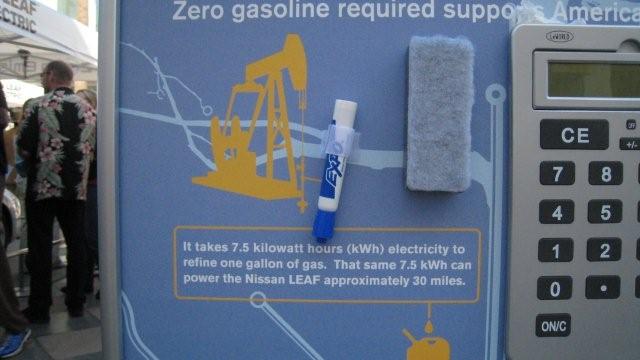
I've been waxing nostalgic lately over the placidity of my blog in comparison to the knock-down, drag-out free-for-all that is Charlie Stross's (where I guest-blogged for a couple of weeks this summer). So I thought I'd share an interesting bit of data that came across the twitterverse yesterday and (while it may not be news to you, is news to me) bears some contemplation. It is simply this:
According to various sources, including apparently the United States Department of Energy, it takes between 4 and 7.5 kWh of energy to refine one gallon of gasoline. To drill and transport that gas takes another 1.5-3 kWh. So, the average energy cost of one gallon of gas is roughly 8 kWh, or even more.
A lot of that energy is provided by fossil fuels, chiefly natural gas; but a big proportion of it is provided in the form of electricity. Those who have totaled it up find that a gasoline-powered automobile uses more electricity to run per mile than a comparable electric vehicle. The total energy cost of the gasoline economy is therefore at least double that of an electric economy.
A corollary to this is that a complete conversion to electric vehicles would not place any more strain on the grid than there is now; it would simply distribute it (because right now much of that energy is going to fixed installations, and with an EV economy it would be going, at least potentially, to millions of individual houses). So a 100% EV economy would not require any increase in electricity production, only an upgrade to the grid (and lots of companies, such as GM, are designing that grid). In fact, all things being equal, in a 100% EV world, electricity demand should go down somewhat.
The remaining issue for electric vehicles, then, would be battery disposal, because their toxicity is high when they contain lead, but with Li batteries is becoming lower and lower.
Except that...
This isn't quite the whole story. What remains to be factored in here is the electricity cost of manufacturing the EV's batteries. I haven't yet found numbers for this cost; if anybody can supply it, that would be helpful.
And while we're at it, we should do a complete parts count for the additional complexity and wear-out rate of internal combustion engines, and factor in the electricity cost of those components...
...And round and round we go.
May 31, 2010
Rewilding Humanity
I'm giving a speech this friday, June 4, 2010 at Innis Town Hall
As part of the 13th annual Subtle Technologies Festival here in Toronto, I will be giving a talk on Friday, June 4 on the subject of Rewilding Humanity. Those of you who followed my old blog, "Age of Embodiment," will have some inkling of what this stuff is about; as will those who may have caught my OsCon speech last summer (which you can catch on YouTube here).
Here's the precis of the talk from the Subtle Technologies website:
Economic sustainability is not enough if human civilization is going to have a long presence on Earth. We need to not only reform our institutions but redefine what they are and how they operate; and we need a new vision of what it means to be human in a world where neither transcendence or apocalypse are viable options. One possibility is “rewilding”–bringing our constructed environments in line with our instinctive and cognitive needs.
This is a good description; but there's a lot more to it than that. If you can make it to the festival, come to the event and we can discuss these and, hopefully, many related ideas.
Oct 08, 2009
Another nail in the coffin for the "tragedy of the commons"
Local communities manage forests better than governments, reports New Scientist
Few ideas have been so thoroughly misused as Garrett Hardin's notion of the tragedy of the commons. Hardin's idea was that "multiple individuals acting independently and solely and rationally consulting their own self-interest will ultimately destroy a shared limited resource even when it is clear that it is not in anyone's long term interest for this to happen" (to quote Wikipedia). There are some historical cases of this happening (i.e. the Boston commons). There are, however, many more cases where it did not; and the idea is often used to try to justify the privatization of public goods.
I've found when I travel to the United States that the tragedy of the commons is a popular idea there, despite the fact that the historical evidence for it is equivocal, at best. Commons were a widespread feature of European life for centuries, and mismanagement of them was extremely rare. Now, New Scientist reports on a new study that shows that forests that are managed locally (i.e. as a commons) sequester more carbon than institutionally, governmentally or privately managed forests.
One significant comment in the article was the following:
They argue that their findings contradict a long-standing environmental idea, called the "tragedy of the commons", which says that natural resources left to communal control get trashed. In fact, says Agrawal, "communities are perfectly capable of managing their resources sustainably".
This really comes as no surprise. But it needs to be reinforced, particularly for people who've drunk the koolaid of the notion that public goods either can't exist or can't be managed efficiently.
Sep 20, 2009
Things may be about to change
...In a big way
While our attention was elsewhere, a truly earth-shattering change has been in the wind--a development most experts have dismissed as impossible, but which now increasingly looks like it is going to happen.
According to Lyle Dennis over at the AllCarsElectric blog, EEStor has applied for certification from the Underwriter's Laboratories for its ultracapacitor technology. If this is true, then the secretive company may really have succeeded in creating the ultimate in electricity-storage technology: a device capable of running your car for hundreds of miles on one charge, and of recharging in under five minutes. A device that is not a battery, and hence never wears out. A technology that would make intermittent power generation sources such as windmills directly competitive with baseload generation sources such as coal.
Canadian electric car company Zenn Motors has licensed EEStor's technology for a soon-to-be-built fully electric sedan. Zenn is betting the farm on EEStor, and they seem remarkably confident. Naturally, we hear outrageous claims about new technologies nearly every day; and many industry watchers have been skeptically tracking EEStor for years. The expectation has been that any day now, the company would disappear, and its executives would later be found living high off the land in Ecuador or somewhere. That hasn't happened, and now the company appears poised to release an actual product--according to Zenn, by the end of the year.
If it happens, this will be a truly disruptive change. It would be nothing less than the first nail in the coffin of the fossil fuel age.
And here's more on the developing story, from Zenn's point of view.
Apr 16, 2009
Solar power sats get real; and more on the Verne gun
Lighting the fuse and running away
Solaren corporation has signed a deal with Pacific Gas & Electric to orbit a 200 megawatt solar power satellite by 2016. I mention this not because the news is amazing (it was inevitable, really) but because their plan gives me some nice numbers to plug into my Verne gun calculations. 
You might remember my enthusiasm over Next Big Future's recent discussion of Project Orion and the spinoff notion of using nuclear bombs to loft very large payloads into space (wheeee!). I called this idea the Verne gun in a feeble public relations attempt. Anyway, Brian Wang's calculations over at NBF gave a figure of 280,000 tons as the lift-capacity of a single 10-megaton bomb. At the time, I suggested using ten or so of these suckers to lift an entire continental powersat infrastructure into space. But I didn't have hard numbers about how much mass equaled how much power.
Solaren have conveniently stated that their 200 megawatt, self-assembling power transmitter could go up in five launches of 25 tons each. Solar power satellites are far more efficient per-solar-cell than ground-based plants, so they have a much smaller industrial footprint and almost no environmental footprint at all. They run 24 hours a day. So that means that the engineers at Solaren can do 200 megawatts of baseline power with 125 tons orbited. To put it another way:
1 gigawatt baseline power = 625 orbited tons
Launching this much mass using conventional rockets is expensive, but obviously not entirely out of line, or they wouldn't be doing it. But, here's a question: how much baseline power (97% uptime) could be orbited using a 10 megaton Verne shot? The answer: 448 gigawatts.
The United States currently uses 4 terawatts of power per year. About half of that is coal. So four firings of the Verne gun could orbit enough power to obsolete the entire American coal-power system.
The big problem wouldn't be radiation from the launches (which would be effectively zero) but the astronomical insurance costs attendant on putting so many eggs in one launch basket. Maybe a few dozen 100 kiloton shots would be better...
Mar 12, 2009
Light pollution: space elevator show-stopper?
And what would the 'light footprint' of solar power satellites be?
With the addition of its final set of solar panels, the international space station is slated to become the second brightest object in the night sky--brighter than Venus. Now, admittedly the ISS is the size of a football field, but it's also three hundred kilometers away from the Earth directly above the plane of its orbit--but much further away for most of the people who see it. Thousands of kilometers, for most of us.
Consider this: on any given night, you can look up (if you're not in a city that already drowns the stars) and see satellites. They're hundreds of kilometers away, and the biggest are no larger than a compact car--yet you can see them. Most are the size of a barrel, but perfectly visible.
Consider Bradley Edwards' ribbon design for the space elevator cable. This would be a meter or two wide and curved, so that it is effectively visible from all angles. So it's about the width of a barrel, but infinitely longer. Its reflective surface over one kilometer's distance would be at least as great as the ISS; but please multiply that light output by 35,000 because that's how many kilometers long it would have to be. A Hoytether (open meshwork) design would presumably reflect less, but how much less?
You could paint the ribbon black. Then again, how much would a coating weigh that had to cover 1 meter x 35 million meters of area? The black coating would heat the cable because the sun is so intense in orbit, so you wouldn't want it to be totally absorptive. But here's the thing:
The moon is black.
Actually, overall the moon's surface is about the shade of an asphalt highway. It absorbs almost all the light that hits it. The moon appears pearly white to us only because of the tiny fraction of light that's reflected off the lunar blacktop. So even a mostly-black ribbon would look brilliantly white to us on the ground.
As if all this were not enough, the only practical means of powering the climber cars (which would be visible too) appears to be multi-megawatt lasers, aimed at solar cell arrays on the climbers. As Wikipedia puts it:
The proposed method is laser power beaming, using megawatt powered free electron or solid state lasers in combination with adaptive mirrors approximately 10 m wide and a photovoltaic array on the climber tuned to the laser frequency for efficiency.
So, the climbers are in the cross-hairs of, essentially, a set of a huge spotlights. Maybe you could use infrared or ultraviolet lasers, but if not, then even for the most efficient solar cells (40% or thereabouts) 60% of the laser light will be absorbed or reflected. Add to that light from the sun reflecting off the (presumably large) collectors, and you get something fiercely bright climbing the already bright cable.
This issue doesn't just affect the space elevator, by the way. It's also relevant to any substantial effort to place solar power satellites at geosynchronous orbit. Their immense surface area would pretty much guarantee that they'd shed a vast amount of light on the Earth.
But why should we care? Here again we can refer to Wikipedia, in its entry on light pollution:
Life exists with natural patterns of light and dark, so disruption of those patterns influences many aspects of animal behavior. Light pollution can confuse animal navigation, alter competitive interactions, change predator-prey relations, and influence animal physiology.
...Studies suggest that light pollution around lakes prevents zooplankton, such as Daphnia, from eating surface algae, helping cause algal blooms that can kill off the lakes' plants and lower water quality.
Lots of other life forms are affect--everything from birds to frogs. It doesn't take very much light to have a big effect. So, in the absence of any direct physical effects, the space elevator would still have a large, if not catastrophic, ecological impact.
I wish this weren't true. I'm a big fan of the elevator, and an even bigger fan of solar power satellites. But the devil, as they say, is in the details. If these structures cause the amount of light pollution I'm suggesting, then they are very far from being green options for energy and transport--regardless of how much carbon they may offset.
Mar 07, 2009
So here's the plan
Conquering space in two easy steps
Further to the discussion about Brian Wang's treatment of Orion and its offshoot, the Verne gun, if you look at the comments to my previous post, Adam Crowl suggests that peak acceleration for Brian's gun would be about 3700 gravities. He also suggests ways of reducing that, primarily by using a nuclear charge to energize hydrogen gas and have that push the ship. (I'm not sure that's the most efficient way to go, though, because the Orion design depends on the efficiency of energy transfer to the pusher plate and requires close proximity to the charge.)
In any case, this figure of 3700 g's suggests something: some things would be able to take it (like hardened electronics, tight rolls of thin-film solar cells, and liquids like water or rocket fuel) but others (like people and furniture) would not. In one of Brian's latest posts, he talks about the Mercury laser, which might make practical laser-initiated fusion happen. This piece makes me wonder what the total mass of the system minus the supporting building structure would be (because that bears on how practical it would be for fusion powered spacecraft) but also reminds me that laser launch systems have only been waiting for this one development to become practical.
So here's the plan: launch a few hundred thousand tonnes of rugged stuff using the Verne gun, and send up the rest a tonne at a time using a laser launch system. You can even run the laser launch system off renewables if you want to be green; and after the first few launches, you end up running it off beamed power from the first solar power sat you put up. True bootstrapping through hybrid launch technology.
Mar 06, 2009
A sabot for the Verne gun
Further to the previous post: how to avoid 10,000 g's of acceleration
I have to admit I got a bit ahead of myself in the post below, in which I renamed the nuclear cannon the Verne gun and described some of what you could do with it. As it stands, the idea would only work for cargoes that could withstand tens of thousands of g's of acceleration---which in practice would amount to fuel, raw iron and a few other simple items like that. Still valuable to orbit, but a bit limiting.
So, here's a proposal to refine the idea a bit: the sabot. In this variation of the Verne gun, you don't try to reach escape velocity. The blast that sends up the ship only needs to loft it about 100 kilometers---above the atmosphere, but not into orbit. The bulk of the ship's mass is in fact acceleration padding--a sabot or shell around a more conventional rocket-powered craft. After an initial acceleration (still on the order of hundreds of g's at least) the sabot separates from the cargo at 100 kilometers, lightening the load and permitting the contained rockets to fire. This lighter craft then enters orbit under rocket power.
An alternative to rockets would be to catch the ship at the top of its trajectory using an orbiting tether (a huge one, if we're catching tens or hundreds of thousands of tonnes!). In either case, the acceleration shielding for the initial launch falls back into the ocean and what enters space is pure cargo.
Using a sabot might allow us to launch more fragile cargoes than the straight shot version. I now doubt that you could launch, for instance, solar power sats without a sabot, though sending up a space elevator would probably still work.
Toby Buckell informs me, by the way, that Niven and Pournelle used the idea of the nuclear cannon in their alien-invasion novel Footfall. Let's get precedent straight here---as far as I know, they did it first in science fiction.
Mar 04, 2009
The Verne Gun
Kickstarting the REAL space age
Recently I talked about one of my favourite blogs, Brian Wang's Next Big Future. He and his team are a veritable fountain of ideas, and this week they've outdone themselves with a series of pieces on Project Orion and its offshoots. Now, I freely admit that they've done all the heavy lifting here (so to speak) but I'm going to take one of their ideas and run with it anyway.
A couple of the salient posts on Project Orion are The Nuclear Orion Home Run Shot, and Pieces of a True Nuclear Cannon. Now, Orion was the 1950s-era American project to build a nuclear-bomb powered spacecraft. Three facts stand out about the project:
- It could have worked, and would have put unlimited amounts of mass into space for less than $1 a kilo.
- The biggest vessel contemplated by the Orion team would have weighed 8 million tonnes, and would have been bigger than the Great Pyramid.
- The sucker wouldn't have incinerated, flattened, and irradiated nearly as much real estate as you might think.
Still, for some reason the project was canceled around 1964.
In contemplating the glory that almost was, it's tempting to imagine what could have been accomplished with Orion. One thought I had was that, well, maybe you could just use it once: do the full-out 8-million tonne monster and use it to launch, in one shot, enough solar satellite infrastructure to obsolete every North American coal plant overnight. According to a rational moral calculus, if Orion works it should be used in such a way, because the number of people who would die worldwide from the beast's fallout would be trivial compared to the number saved by reductions in air pollution from coal. (Three million people die from air pollution each year; what they point out over at Next Big Future is that Orion could be calibrated to limit its fallout deaths to no more than a few dozen per launch, even for the biggest ship).
Still, there would be some place on Earth that would suffer from such a launch, and one thing we've learned is there is no truly "empty" land. Even if our moral calculus could be extended to other species that would be saved by greening our power, it would be better if there were some way to launch such huge masses without exposing the biosphere to nuclear explosions and fallout at all.
There is. I call it the Verne gun because frankly, a name like THE ATOMIC CANNON would just not go over well in certain circles. In any case, the principle is the same as Verne's original idea, but using modern technology: you set off a nuclear charge underground where the blast, heat, radiation and fallout can all be contained, and use Orion-type technology to direct its energy into orbiting a very big, very heavy spacecraft. This vessel would experience hundreds to thousands of g's of acceleration--you couldn't put humans in it. But Wang calculates that a 10 megaton bomb could put 280,000 tons into orbit with zero radiation escape into the biosphere. Since dozens of bombs were exploded in exactly this way from the 50's to the 70's, we know this can be done. And Orion's researchers proved nearly every one of their theories about Orion. What they couldn't test at the time can now be simulated accurately by today's supercomputers, without the need for a test program.
Such an orbital gun could be used multiple times. Here's what you could do if you could put 280,000 tons into orbit in one shot:
- Put 1.5 terawatts of clean solar power into orbit with less than ten launches. Obsolete coal and petroleum power production with green baseline power, using less than a 10th the number of solar cells as you'd have to install on Earth to capture the same amount of sunlight.
- Orbit an entire space elevator with one launch. Set it up, retire the gun, and get on with a clean space age.
- Do the same thing with an orbiting greenhouse infrastructure. Drop solar-powered mass drivers on the moon to feed a continual stream of building material to the building sites.
- Orbit fuel depots to drop the price of conventional rocketry to orbit through the floor. One shot and access to space for NASA becomes 10 times cheaper.
- Send up a telescope so big that it can image the continents of planets circling other stars.
- Put up one or more of those cool gigantic orbiting space station wheels that are showcased so dramatically in the movie 2001: A Space Odyssey.
- Send an entire colony's worth of material to the moon or Mars. With a second shot, put up an interplanetary cycler ring, tether launch system or other permanent mechanism for shuttling people to and from the colonies.
- Toss a couple hundred thousand tons of nuclear waste into the sun, where it won't bother us anymore. (Trust me, the sun won't notice.)
- Launch an empty Orion ship, send its fuel up the safer space elevator, and send an expedition to Saturn, or a probe to the next star.
I'm not going to suggest orbiting a sunshade to head off global warming, because that's no solution for problems like ocean acidification. --In any case, you can certainly think up other cool stuff we could do; and notice that some of these options, like orbiting fuel depots or a space elevator, can easily bootstrap us out of having to use the gun more than once or twice.
Oh, and of course, there's one more thing you could do with it, but since you'd need to get signoff from all the members of the nuclear club to use it at all, this one's a bit less likely:
- Orbit a huge frikkin death star platform with ATOMIC LASERS and MISSILE RACKS and RAIL GUNS and aim them at anybody you don't like.
Jul 19, 2008
"Green Shift" is mainstream policy
There's lots of FUD being spread about the Liberals' proposed carbon tax. Similar taxes have been used in other countries for years now, and they work
If the Conservatives had come up with the Green Shift policy, I would be voting Conservative. If the NDP had come up with it, I'd be voting NDP. In fact, in Canada it's the Green Party that first developed the idea of a revenue-neutral transition from taxing income to taxing waste. Who came up with it doesn't matter. What matters is that it happen, and soon.
The fact is that tax plans like this are not new. Germany has been employing a similar tax for ten years now, and Germany's record with green tech is stellar: 250,000 jobs directly relating to sustainable technologies is nothing to sneeze at. Other countries that are either enacting such measures now or are intensively studying them include the UK, Portugal, and the Netherlands.
The devil's always in the details, but tax shifts like this are fundamentally simpler than other measures the provinces are already planning, such as the cap and trade market for carbon that is a major goal of the Western Climate Initiative (which 70% of Canadians now belong to). Tax shifting is simple: the government stops taxing you for being productive, and starts taxing you for being wasteful. This means more money in our pockets for at least two reasons: first, the carbon tax is immediately offset by income and business tax reductions; secondly, making waste expensive gives companies incentive to become more efficient, and efficiency drives down costs. This is why costs don't get passed on to the consumer, and it is why everything eventually becomes cheaper rather than more expensive.
When demand for fossil fuels increases, their prices go up. When demand for renewables like wind or solar power increases... their prices go down.
You can have more money in your pocket while making a huge difference to the environment. And this tax would not apply to gasoline.
The reason the Conservatives are complaining about the "Green Shift" proposal is that it would have been a perfect policy for them--more money all around with less of a hit on the consumer--but they didn't think of it first.